
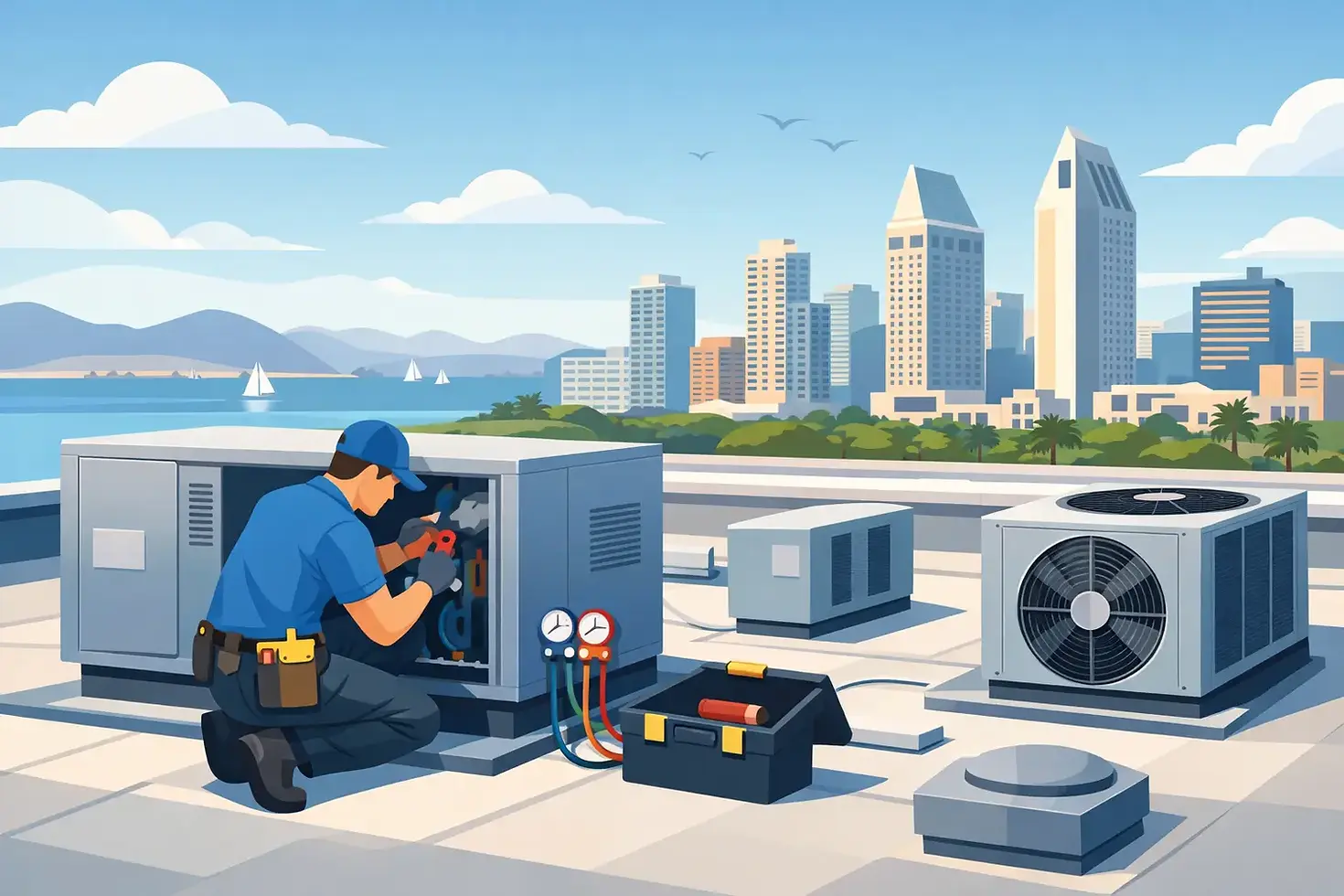
Rooftop Unit Repair San Diego: What to Fix Fast

A failing RTU rarely picks a convenient time. It shows up as a hot office at 2 p.m., uneven cooling across tenant spaces, rising energy bills, or a store that never quite gets comfortable no matter how long the system runs. If you need rooftop unit repair San Diego service, speed matters, but so does getting the diagnosis right the first time.
Rooftop units are built for hard work, especially in commercial settings where comfort affects employees, customers, equipment, and daily operations. In San Diego, the weather is easier on HVAC systems than in many markets, but salt air near the coast, long operating hours, deferred maintenance, and aging components can still wear an RTU down faster than expected. The result is often a system that does not fully fail at first. It just gets louder, less efficient, and less reliable until a small issue turns into a disruptive one.
When rooftop unit repair in San Diego becomes urgent
Some RTU issues can wait a day or two. Others should be addressed immediately. If the unit is short cycling, blowing warm air during cooling mode, tripping breakers, leaking water into the building, or making new grinding or banging sounds, that is not the time to hope it clears up on its own.
For commercial properties, urgency is not only about comfort. Restaurants, retail spaces, offices, medical environments, and mixed-use buildings all rely on steady temperature control and ventilation. A weak rooftop unit can affect indoor air quality, employee productivity, customer experience, and even inventory or equipment performance. For property managers, one struggling RTU can quickly become multiple complaints from tenants.
There is also the cost side. Waiting on repairs often leads to compressor strain, blower motor failure, damaged belts, frozen coils, or electrical issues that spread beyond the original problem. A clogged drain line or dirty coil may start as a maintenance issue, but if ignored, it can create repair work that is far more expensive than the first service call.
The most common rooftop unit problems
Rooftop units are packaged systems, which means several major components work together in one cabinet. That is efficient from a footprint standpoint, but it also means one weak link can affect the whole system.
Electrical failures are common. Contactors wear out, capacitors weaken, wiring loosens, and control boards can fail over time. These problems often show up as intermittent starts, inconsistent cooling, or a unit that simply will not power on.
Airflow issues are just as common. Dirty filters, clogged evaporator coils, worn belts, failing blower motors, and blocked duct connections can all reduce performance. When airflow drops, the system runs longer, cooling suffers, and energy use climbs.
Refrigerant problems are another frequent cause of poor performance. Low refrigerant may point to a leak, and adding charge without finding the source is usually a short-term fix. An RTU that is low on refrigerant may struggle to hold setpoint, freeze at the coil, or run continuously without properly cooling the space.
Then there is the wear that comes from being on the roof. Exposure to sun, wind, salt air, and debris can age panels, seals, electrical connections, and condenser coils. In coastal parts of San Diego, corrosion can become a serious factor, especially for units that have gone years without consistent inspection.
Why diagnosis matters more than a quick patch
A lot of rooftop unit problems look the same from inside the building. Occupants notice weak airflow, warm air, odd smells, or rooms that are too hot. But the cause could be as simple as a failed capacitor or as serious as compressor damage.
That is why proper rooftop unit repair in San Diego should start with a full system evaluation, not a guess. A technician should be checking electrical components, verifying refrigerant pressures, testing airflow, reviewing thermostat and controls operation, and inspecting the condition of the coils, motors, belts, drains, and safety switches.
The goal is not to sell a bigger repair than you need. The goal is to stop repeat breakdowns. A temporary workaround may get a unit running for the day, but if the root issue is still there, you are likely to end up paying for another service call soon after.
This is especially important for businesses with multiple zones or multiple rooftop units. If one unit fails and another is already under strain, the second problem may not be far behind. Good repair work should account for the bigger operating picture, not just the immediate symptom.
Repair or replace? It depends on the unit
This is one of the most common questions property owners ask, and the honest answer is that it depends.
If the rooftop unit is relatively new, the cabinet is in good shape, and the repair is limited to a motor, capacitor, contactor, belt, sensor, or similar component, repair is often the right move. The same goes for refrigerant leaks that are isolated and repairable, assuming the rest of the system is still in solid condition.
Replacement starts to make more sense when the unit is older, repairs are becoming frequent, efficiency has dropped noticeably, or major components like the compressor or heat exchanger are failing. Corrosion can also push the decision toward replacement, particularly in coastal environments where structural deterioration and coil damage may continue even after one repair is completed.
Budget matters too. Sometimes a repair is the right immediate decision because operations cannot pause for a full replacement project. In those cases, a clear repair now and replacement plan later is often the most practical path.
What to expect from a service call
A professional RTU repair visit should feel clear and organized, not rushed. The first step is identifying the complaint and confirming the actual operating condition of the system. From there, the technician should inspect the unit, test components, and explain what failed, what caused it, and what options make sense.
For some issues, the fix is straightforward and can be completed the same day. For others, especially when specialty parts are involved or the unit is older, timing may depend on part availability. What matters is transparency. You should know whether the repair is a short-term correction, a durable fix, or a sign that larger planning is needed.
That direct, accountable service model matters. When the company diagnosing the issue is also the one standing behind the repair, communication tends to be cleaner and outcomes more consistent. That is one reason many San Diego property owners prefer working with a local HVAC contractor rather than rolling the dice on outsourced labor. BlueBay Mechanical is built around that kind of direct service - keeping you comfortable with clear communication, clean work, and quick service when timing matters.
How maintenance reduces emergency rooftop unit repair in San Diego
The best emergency repair is the one you never need. Routine maintenance does not eliminate every breakdown, but it catches a lot of the problems that lead to urgent calls.
A well-maintained rooftop unit is more likely to hold temperature, move air properly, and operate efficiently through peak demand. Coil cleaning, filter changes, drain checks, belt inspection, electrical testing, and refrigerant evaluation all help reduce wear on the system. Small corrections made during maintenance are usually far less expensive than emergency repairs made after a full failure.
Maintenance is especially valuable for commercial buildings with long operating hours. If your unit serves customers, staff, tenants, or critical business functions, preventive service is not just a box to check. It is part of protecting the space, the equipment, and the people inside it.
Choosing the right local HVAC team
Not every contractor approaches RTU repair the same way. For rooftop systems, experience matters because access, safety, controls, and equipment configurations can vary widely from one building to another.
Look for a San Diego HVAC team that communicates clearly, shows up prepared, and focuses on practical outcomes. You want a contractor who can identify the actual problem, explain trade-offs, and recommend repairs that fit the age and condition of the unit. You also want accountability. If there is a callback or a larger issue tied to the original repair, it should be easy to get the same team back involved.
Fast service matters, but quality matters more. A rushed repair that misses the cause of the failure can cost more than waiting a little longer for the job to be done correctly.
When your rooftop unit starts acting up, the smartest move is usually the simplest one - address it early. A timely inspection can protect comfort, reduce downtime, and keep a manageable repair from turning into a much bigger disruption.


Comments